Introduction to Urban Stargazing
While cities produce significant light pollution, urban rooftops offer surprisingly good stargazing opportunities when approached strategically. This guide combines rooftop camping with celestial observation, creating unforgettable experiences that connect campers with the cosmos despite urban settings.
Understanding Urban Light Pollution
The Challenge
City lights wash out fainter stars and deep-sky objects, limiting what's visible compared to dark-sky locations. However, the Moon, planets, and brighter stars remain visible even from city centers.
Opportunities
Higher elevations reduce light pollution slightly. Looking toward darker sky areas (often away from downtown cores) improves visibility. Timing observations during late-night hours when commercial lighting decreases also helps.
What You Can See from Urban Rooftops
Always Visible
The Moon provides endless observation opportunities through any light pollution. Phases, maria, and crater details are easily observed.
Planets
Venus, Mars, Jupiter, and Saturn are all visible from urban locations. Even modest telescopes reveal Jupiter's moons and Saturn's rings from city rooftops.
Bright Stars and Constellations
Major constellations like Orion, the Big Dipper, and seasonal highlights remain identifiable. The brightest stars pierce through light pollution effectively.
Occasional Events
Meteor showers, lunar eclipses, and planetary conjunctions provide special observation opportunities that overcome light pollution through sheer brightness.
Equipment Recommendations
Naked Eye Stargazing
No equipment needed to begin. Star maps or astronomy apps help identify visible objects. Red LED lights preserve night vision when consulting references.
Binoculars
Quality 7x50 or 10x50 binoculars reveal impressive lunar detail and gather enough light for extended star fields. Easier to use than telescopes and highly portable.
Telescopes
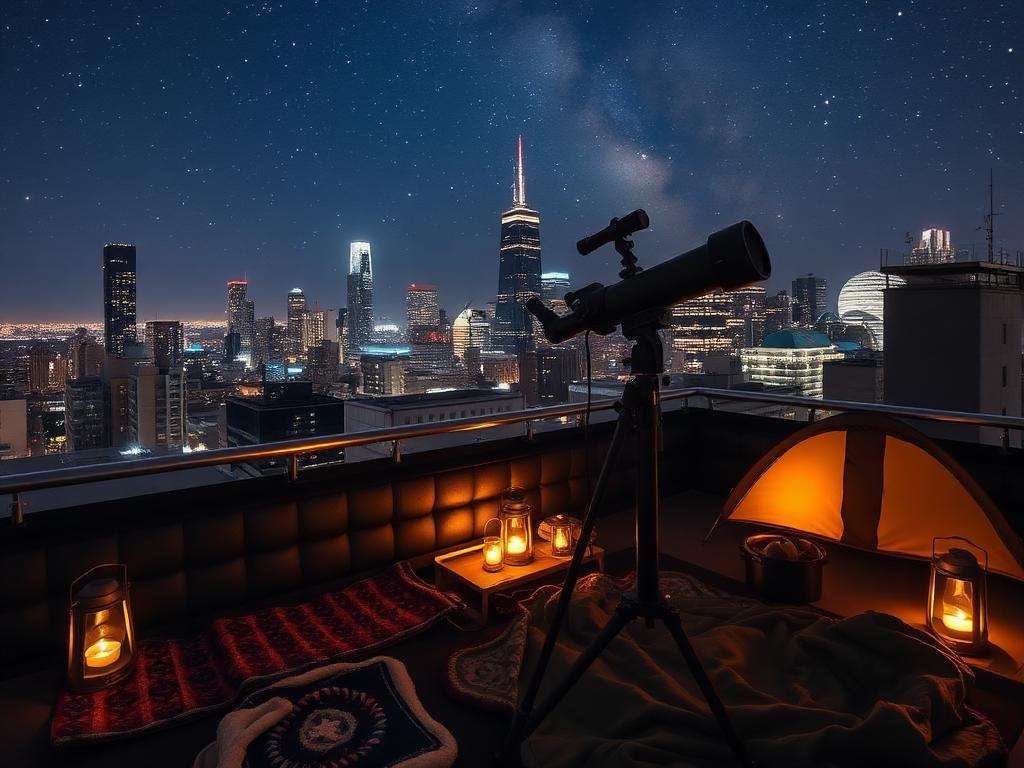
Compact refractors or tabletop reflectors suit rooftop use. Avoid large, heavy equipment that's difficult to transport. Computerized goto mounts simplify object location.
Photography
Smartphone adapters for telescopes enable lunar photography. More serious astrophotography requires dedicated equipment and tracking mounts.
Planning Your Stargazing Camp
Timing
New moon phases provide darkest skies. Check astronomical calendars for meteor showers and planetary events. Clear nights obviously essential – check forecasts carefully.
Orientation
Know which direction your rooftop faces. Southern exposure (in the Northern Hemisphere) provides the widest celestial viewing arc.
Comfort Considerations
Extended stargazing requires comfortable positions. Reclining camp chairs or loungers allow long observation periods. Warm clothing essential as temperatures drop.
Sample Stargazing Schedule
Dusk
Set up camp and equipment as daylight fades. Observe the first stars appearing and track planets emerging from twilight.
Early Night
Moon observation if visible. Locate bright planets and major constellation figures.
Late Night
As light pollution decreases slightly and eyes fully dark-adapt, look for fainter objects. Peak meteor shower activity often occurs after midnight.
Pre-Dawn
Some of the year's best stargazing occurs in early morning hours. Winter constellations visible in spring pre-dawn, and vice versa.
Seasonal Highlights
Summer
Milky Way core visible from darker urban edges. Summer Triangle dominates overhead. Saturn and Jupiter often well-positioned.
Fall
Andromeda Galaxy visible as a fuzzy patch even from cities on clear nights. Autumn meteor showers including Orionids and Leonids.
Winter
Orion and its associated objects dominate winter skies. Cold, clear nights often provide best visibility. Geminid meteor shower peaks in December.
Spring
Leo and other springtime constellations offer new observation targets. Galaxy season begins for those with telescopes and darker sky access.
Combining Camping and Astronomy
The Magic Connection
Sleeping under the stars creates natural connection to celestial observation. Wake periodically to observe constellation positions changing through the night.
Educational Opportunity
Rooftop stargazing provides excellent opportunities to learn constellation patterns and understand celestial mechanics through direct observation.
Conclusion
Urban rooftop stargazing proves that meaningful astronomy experiences don't require remote dark-sky locations. By understanding what's observable, equipping appropriately, and timing strategically, rooftop campers can connect with the cosmos from their city locations.